
Imagine trying to monitor and manage the phenomenon in far-flung remote locations where basic infrastructure and services are inevitably lacking due to factors such as extreme isolation.
Add severe weather and the impact of social determinants of health, and the true enormity of trying to handle potential cases of AMR in companion animals in remote communities across Australia becomes starkly evident.
More than companions
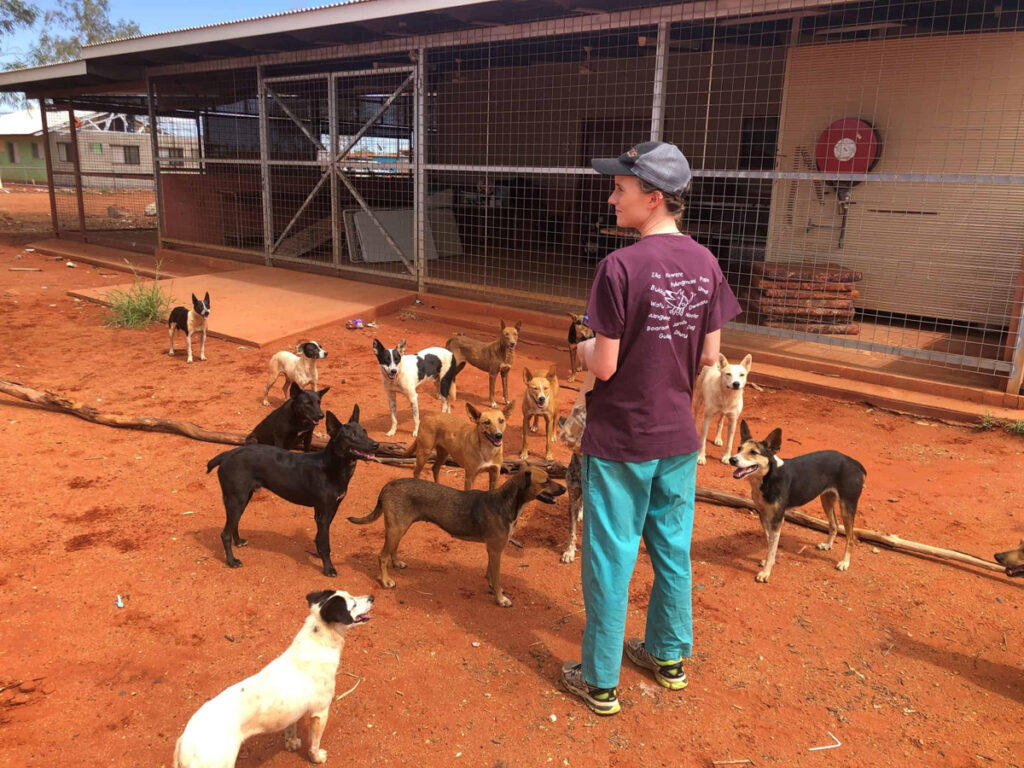
Dogs and, more recently, cats are often integral to many Aboriginal and Torres Strait Islander communities, explains veterinarian Dr Jessica Hoopes, the One Health Research Coordinator for Animal Management in Rural and Remote Indigenous Communities (AMRRIC) – a national not-for-profit working with rural and remote Aboriginal and Torres Strait Islander communities to support the health of companion animals.
Many of these animals are beloved family members but also often have roles as physical and spiritual protectors or loyal hunting companions.
“In some communities, relationships with dogs run even deeper with representations as totems within kinship systems and formal recognition of them within family groups,” Dr Hoopes explains. “Every community is different, with different priorities, goals, and beliefs. This adds to a complex interplay of needs, which are important to consider when providing animal health products, such as basic medicines – like deworming treatments – and veterinary services.”
Without access to regular animal health services, companion animals in many remote communities face overpopulation, which contributes to a greater likelihood of poor health and higher rates of infections compared to those seen in urban areas.
“
For some communities, access to even basic animal health products is impossible at some times of the year.
Dr Jessica Hoopes
Distance matters
The most fundamental impediment, however, to providing the basic veterinary services that underpin the delivery of culturally appropriate veterinary health care, which includes AMR stewardship, is geographical distance.
Preliminary results from a study being undertaken by AMRRIC and its research partners show that for Aboriginal and Torres Strait Islander communities in Western Australia, Northern Territory and Queensland, the “as the crow flies” distance to the nearest in-state veterinary clinic is on average about 200 km.
“Beyond that, road travel and inclement weather can influence access to these communities and to vet services,” Dr Hoopes adds. “For some communities, access to even basic animal health products is impossible at some times of the year.”
To help meet the challenges, AMRRIC works closely with local governments, which often organise visiting veterinarians to deliver community-wide animal health and management programs. These tend to focus on reproductive control, such as de-sexing animals, and the delivery of parasite treatments, as well as basic medicine, and surgeries in response to animal health concerns.
“But these [programs] usually rely on government or philanthropic funding, and are limited as a byproduct of resource constraints,” Dr Hoopes says, adding that when vet teams do reach remote communities – when weather conditions and funding allow – available infrastructure is often limited. “There’s no vet clinic, so we’re operating out of a makeshift clinic that’s been created in a community facility such as a hall or under a lean to, to provide shelter from the elements.”
Visiting vet teams must take whatever they think they’ll need with them. “Autoclaves, for example, which are really important for sterilising surgical instruments, are about 50 kilos and don’t travel well over corrugated roads,” Dr Hoopes says, explaining that this restricts the methods used to prevent and reduce infection during treatment, especially surgery.
The general entrenched lack of access to vet services, reliance on externally funded and sporadic population-level programmes, and difficulty for remote communities to access basic medicines between visits make antibiotic delivery more difficult and erratic. These limitations also make it extremely hard to closely monitor the effectiveness of antibiotics and follow up on their use.
“If, for example, we want to run a bacterial culture to find out what bacteria are causing an infection, we only have a limited timeframe to get the samples to the lab. These samples also need to be kept at certain temperatures for them remain viable,” Dr Hoopes says. “But out in the field, our teams may not have dependable refrigeration and may not be able to get mail out for a week. If the samples cannot be properly stored and shipped on time, the test results may not be reliable.”
“
Because of the better infrastructure for [human] health than in the veterinary setting in remote areas, there may be greater awareness around AMR in the human context than there would be in the veterinary context.
Dr Jessica Hoopes
Additional impediments
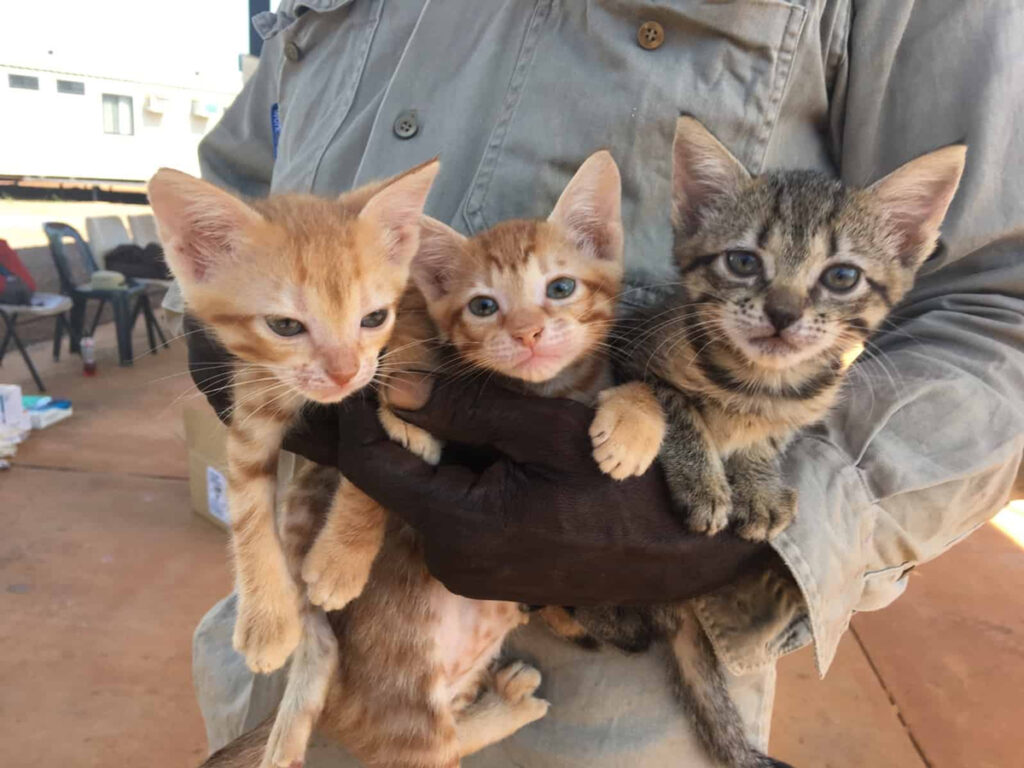
Contrary to common misconceptions, most companion animals in remote Aboriginal and Torres Strait Islander communities in Australia are not strays. “Most of them are owned, it may just be in a different paradigm from the way Western culture “owns” animals,” Dr Hoopes says. “And so, as respected members of the community, they receive considerable autonomy and are allowed to roam freely throughout the community.”
Because of this, practices such as caging are not widely used. There may, as a result, be difficulties ensuring an animal is available at prescribed dosing schedules, which can interfere with the effective use of antibiotics.
“I think the other big challenge is the lack of access to follow-up appointments with the vet. Being able to monitor progressive treatment and therapeutic efficacy is tough when a lot of people don’t even have reliable access to phones or internet, so it can be really difficult for people in remote areas to contact their vet team if they have concerns,” Dr Hoopes says.
All these massive obstructions to the delivery of veterinary care in the first place understandably impact the delivery of sound AMR stewardship, which relies on diagnostic cultures and definitive laboratory diagnoses to identify resistant infections.
“The other problem is that effective and affordable animal healthcare products are rarely stocked locally, making it extremely difficult for remote pet owners to access preventative treatments like anti-parasitics or medicated shampoos. So, if [a dog] has an infected wound, it may also have a skin problem like scabies [which complicates treatment] and dealing with multiple problems at the same time makes it harder to detect resistant infections if they are there,” Dr Hoopes says.
So far there’s very limited knowledge on the status of resistance in companion animals in these communities, although the few studies that have been done suggest it’s low.
“But we do know that in human healthcare settings in remote communities, there are often higher rates of antimicrobial resistance,” Dr Hoopes says. “Because of this, and because of the better infrastructure for [human] health than in the veterinary setting in remote areas, there may be greater awareness around AMR in the human context than there would be in the veterinary context.”

Liaison and education help
AMRRIC and its community partners have developed a collaborative, long-term approach to animal management; combining local knowledge with decades of experience in remote veterinary service delivery, to find unique solutions to the challenges associated with remote, field-based veterinary work. AMRRIC works with communities upon invitation and builds relationships with local liaison staff who also help ensure that everything vets do is culturally appropriate, as every community is unique. “We also have a great education team that develops specific resources for each community, with local translations where possible,” Dr Hoopes adds. AMRRIC is also trying to build awareness about AMR through these contacts.
“Veterinarians and medical doctors are the first line of defence in making sure antibiotics are being given appropriately and ensuring that owners have the information to medicate their pets and to understand why that’s important,” Dr Hoopes says.
Ultimately, despite facing unique challenges that other communities don’t have, supporting Australia’s remote communities and working with them to support collective stewardship holds many of the answers to managing AMR, just as it does everywhere else.
Karen McGhee is one of Australia’s most experienced science journalists and editors. She has written for dozens of local and international publications and websites including Scientific American, Nature and Australian Geographic.
You may also be interested in:

Veterinary pharmaceutical packaging – a global One Health challenge