

Day 1 Keynote – From declaration to delivery

Summary
The keynote and panel framed political declarations as useful instruments for sustaining momentum, but insufficient on their own to deliver antimicrobial resistance (AMR) outcomes. The 2024 UN political declaration was positioned as a time‑bound, target‑driven platform that can help maintain a ‘drumbeat’ of attention through to the 2029 review if countries translate commitments into costed, budgeted national plans with clear accountability, sustained financing, and cross‑sector implementation.

“Only through aligning our diplomacy, aligning the work that we’re doing internationally with our investments, can we cut the outbreak risk and build resilient health systems.”
Chris Cannan, Australia’s Ambassador for Global Health
A recurring theme was that effective delivery depends on (1) a small number of credible, measurable targets, (2) strong national and local implementation capacity, and (3) embedding AMR within broader system agendas: health security, food security, WASH/IPC, and sustainable development rather than treating AMR as a stand‑alone vertical program. The discussion also emphasised that delivery requires communicating AMR in multiple ‘languages’ (to secure traction beyond health ministries and build wider ownership.

“We need it (declarations) to be spoken in several languages … economic language, security language, and public health language.”
Jane Halton AO, Chair, Coalition for Epidemic Preparedness Innovations
Intent to impact
Declarations create political momentum, but delivery is the test. The keynote stressed that declarations matter when they set ambitious but achievable commitments, and that progress accelerates when AMR is integrated across human, animal and environmental systems and aligned with practical, cost‑effective interventions.

“We need very few targets because they’ve got to be evidence based, they’ve got to be measurable, they’ve got to be credible, and they’ve got to be achievable. There’s no point in a target that’s not achievable. People just give up.”
“We’ve got to help where the pressure is greatest, where the burden is greatest, and where interventions will produce the biggest gains.”
Dame Sally Davies, UK Special Envoy on AMR
Financing and accountability are the persistent fault lines. Speakers pointed to the gap between countries having plans and countries having resources, noting that only a small share of national action plans are backed by dedicated funding. The panel argued that accountability mechanisms must be simple, accessible, and measurable, with clear ownership across ministries.
Australian examples were used to show both the value and limitation of current surveillance: national reporting can reveal inappropriate prescribing patterns, but the data often arrives too late to guide real‑time clinical decisions. The panel therefore emphasised moving from retrospective reporting to timely feedback loops, including point‑of‑care diagnostics and near‑real‑time performance information that helps clinicians and services change practice quickly rather than receiving results years later.
Behaviour change and communication should be treated as delivery infrastructure. The panel stressed that AMR must be communicated in terms the public and decision‑makers understand, including through compelling narratives and by operating effectively in social media environments where misinformation shapes perceptions.

“Maybe we should call it what it is. You know, deadly infections with no cure. Those powerful stories that we hear about people who have lost loved ones, because of antimicrobial resistance, these terrible infections which cannot be treated, have a powerful impact on the community”
Michael Kidd AO, Australia’s Chief Medical Officer
Actions and considerations for follow‑through to 2029
- Make AMR commitments budgetable and visible by publishing a national AMR and health financing map that itemises domestic funding alongside philanthropic and official development assistance contributions, improving transparency and reducing hidden dependency risks.
- Increase accountability for delivery by tagging each National Action Plan activity as funded, partially funded, or unfunded, and updating this status annually to support prioritisation under fiscal constraints.
- Reframe AMR as an investment rather than a cost when engaging finance ministries and central agencies, to sustain appropriations and protect long‑term programmes.
- Focus implementation on what can realistically be delivered by adopting a small set of measurable, evidence‑based targets and resisting expansion beyond what can be measured, achieved, and linked to impact.
- Use short, time‑bound delivery sprints (for example, 90‑day improvement cycles) to identify and remove binding constraints such as procurement rules, workforce limitations, or slow data pipelines, assigning clear cross‑agency ownership and closing implementation ‘white space’.
- Embed AMR commitments into routine systems by hard‑wiring requirements into accreditation and regulation across hospitals, primary care, pharmacies, veterinary services, and other relevant settings.
- Strengthen surveillance‑to‑action feedback loops so prescribing and stewardship performance is visible, timely, and linked to support and education, not just retrospective reporting.
- Scale access to point‑of‑care rapid diagnostics across frontline settings including primary care, emergency departments, aged care, and pharmacies, with One Health applicability where relevant, to reduce diagnostic uncertainty and inappropriate antimicrobial use.
- Build cross‑government ownership through targeted narratives by developing parallel economic, security, and public health frames so AMR can be championed beyond health ministries.
- Treat communication as part of delivery by investing in proactive explainers, rebuttals, and trusted voices, particularly through social media, to counter misinformation and sustain public momentum.
- Activate accountability through incentive levers by linking senior health system leaders’ performance and remuneration to delivery against agreed AMR metrics, anchored in what is measurable and within their control.
[1] White space is everything that slows delivery without adding value.
It is the unowned, uncoordinated, or unnecessary space between steps where decisions stall, responsibilities are unclear, or processes wait on each other.
Session 1 – Leading the charge or losing ground: The AMR implementation divide
Global ambition to address AMR is rising, but implementation gaps persist. Countries face uneven resources, competing priorities, and national plans that don’t always match local realities or sector needs. This session explores how to turn high-level commitments into workable, country-owned strategies by identifying who must act, how to build lasting programmes beyond donor cycles, and which incentives and accountability mechanisms can finally narrow the AMR implementation divide.

Summary
Speakers examined the gap between global AMR ambition and country-level delivery, recognising uneven resources, competing priorities, and national action plans (NAPs) often don’t ‘stack up’ against on-the-ground constraints. The discussion emphasised that progress depends less on new recommendations and commitments, and more on mechanisms that such as strengthened governance, legal adoption, sustainable financing, and context-appropriate implementation across One Health.

“From a country perspective, the international community should empower countries … and work in a co‑creation way, so that governments feel ownership and continue to take action beyond (provision of) external funding.”
Makara Hak, Advisor – Animal Health, Food and Agriculture Organization (FAO)
Intent to impact
The discussion surfaced a fundamental constraint in national AMR responses: coordination without authority does not deliver outcomes. Many national arrangements sit within a single sector, lack enforceable mandates across government, and are disconnected from the legal and fiscal processes that enable implementation. Where AMR plans are not formally adopted through parliamentary or cabinet mechanisms, they struggle to secure financing, compel cross-ministerial action, or establish accountability.
A clear distinction was drawn between mapping stakeholders and making systems work. While identifying relevant actors is often achievable, aligning incentives, responsibilities, and accountability across them remains the binding constraint. AMR governance frequently excludes critical government departments (ministries of education, the interior, and finance) and under-represents the local implementers who shape antimicrobial use in practice, including farmers, retailers, and professional associations. The result is coordination architectures that look comprehensive on paper but fragment at the point of delivery.
The conversation reinforced that delivery falters when interventions are transferred without adaptation to local conditions. Health system capacity, farming systems, infrastructure, and cultural practice form the foundation for implementation. Assuming uniform readiness across settings leads to strategies that cannot be operationalised, regardless of technical merit.
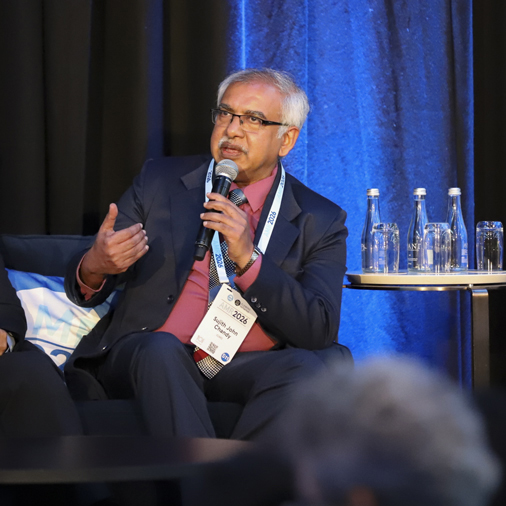
“When you look at the competing priorities in countries, it’s often the loudest or most immediate crisis that gets attention, and AMR gets lost. The question is how we become good mentors and champions, and how we ensure culture, behaviour change, and education sit alongside national action plans.”
Sujith Chandy, Executive Director, ICARS
This misalignment is particularly evident in infection prevention and control. In many contexts, the basic prerequisites for infection, prevention, and control (IPC) such as reliable water, adequate facilities, trained staff, and essential supplies are not in place. In these settings, more activities are needed around prevention.

“Many health care facilities don’t have the infrastructure to actually implement IPC programs … and the tools aren’t there to implement national action plans”
Erta Kalanxhi, Fellow and Director of Partnerships, One Health Trust
Sustainability was framed as a systems challenge rather than a funding question alone. Durable AMR responses depend on governance mechanisms that endure, locally generated burden and cost data that resonate with finance and planning authorities, and the ability to engage public and private actors in ways that create shared ownership. Without credible local evidence, the case for longterm investment remains weak.

“We don’t have locally generated data that quantifies the burden and the cost of AMR in some countries … and so that fundamentally is one of the problems if we are to convince our policymakers to invest.”
Mirfin Mpundu, Founding Executive Director of ReAct Africa and Senior Global Health Expert, Fleming Initiative
Across the discussion, a consistent message emerged: AMR strategies succeed when authority, incentives, evidence, and context are aligned. Moving from coordination to impact requires legal legitimacy, public-private sector co-design, contextappropriate implementation, and country ownership embedded into the delivery architecture.

Actions and considerations for follow-through to 2029
- Strengthen legal adoption pathways for national plans (endorsement and financing mechanisms) so cross-ministry accountability is enforceable rather than voluntary.
- Establish governance arrangements with convening power across sectors so participation and delivery are not constrained by ‘health-led’ coordination structures.
- Explicitly name and include the full delivery actor set such as education, enforcement/interior, economic/finance alongside community-level implementers (farmers, retailers, associations, village workers).
- Prioritise building durable national mechanisms, not isolated project outputs to ensure interministerial coordination in addition to AMR technical capability for ongoing delivery and resource mobilisation.
- Design interventions to match local ‘foundation’ conditions that include WASH/IPC infrastructure, diagnostics capacity, health system configuration, and farming system contexts rather than transferring models unchanged.
- Sequence plans around prevention and basic infrastructure constraints where those constraints block progress on awareness, surveillance, IPC, stewardship, and access.
- Use locally generated burden/cost evidence to strengthen the domestic ownership and financing case and reduce dependence risk as external funding fluctuates.
- Engage private sector actors through co-creation and aligned incentive approaches to support shared ownership and long-term sustainability of AMR solutions.
“A B A B1, do you have your power?
No sir, no sir, I’ve reached the darkest hour.
Misuse for the viruses, animals, food, and farms.
Use me wisely or the bugs will cause you harm.”
Sujith Chandy’s AMR rhyme
1AB = antibiotic
Read the other AMR 2026 reports

Theme 2: Data for decision-making
Theme 3: Investing through an AMR lens

Theme 4: Standards, stewardship, and support

Theme 5: Solution ideation, innovation, and impact
Theme 6: Consumers, communications, and campaigns

Theme 7: Evidence, equity, and economics

Theme 8: Early education