
At the famed George Eliava Institute of Bacteriophages, Microbiology and Virology in Tbilisi, Georgia, a queue forms every morning outside its pharmacy. People with anything from toothache to gut problems line up waiting, but not for what you’d expect.
“If they have a toothache or if you have a scratch on the skin that’s not healing, they don’t automatically go to antibiotics,” says Professor Ruby Lin, deputy director of Phage Australia. “With the toothache, they gargle phage solution; if they have a tummy ache, they have a shot of phage cocktail from the pharmacy.”
Bacteriophage – or phage – therapy is not new. It has been a medical staple of Eastern Europe and Russia for over a century. But as the antimicrobial resistance crisis escalates, threatening to make redundant so many of the antibiotics that western medicine depends on, phage therapy is being rediscovered by the west.
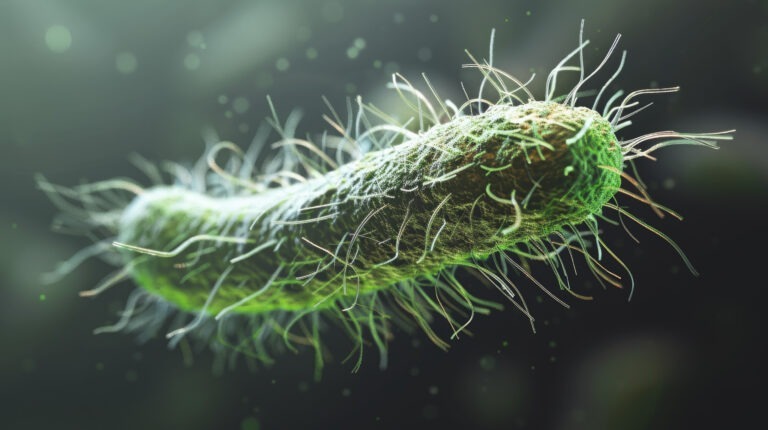
Phages are viruses, and bacteria are their prey. Phages outnumber every other life form on this planet, and have evolved extraordinary diversity to match the diversity of their bacterial targets. That specificity of target, and their deadliness to bacterial but not human cells, is what makes them so useful in medicine.
“
We’ve treated more than 53 patients with phages as part of Phage Australia clinical network.
Professor Ruby Lin
Discovery and rediscovery of phage medicine
Phages were discovered in the early 1900s by French-Canadian microbiologist Felix D’Herelle, and introduced into medical research soon after by Georgian scientist Georgi Eliava (for whom the Eliava Institute is named). Eastern European clinicians quickly adopted them into medical practice, but western medicine instead chose the newly discovered antibiotic penicillin as its bacteria-killer of choice.
That century-long dependence on pharmaceutical solutions to bacterial infection has made the re-entry of phage therapy more challenging than it might otherwise have been.
“Every phage product is going to be different – different genetics, different biology – and so that makes it very difficult to fit in the standard chemical/drug/pharmaceutical pipeline,” says microbiologist and phage researcher Associate Professor Jeremy Barr, from the Centre to Impact AMR at Monash University.
It’s difficult, but not impossible, and there are a growing number of patients in Australia and around the world whose infections have been successfully treated with phage therapy.
“We’ve treated more than 53 patients with phages as part of Phage Australia clinical network” says Professor Lin. “In Australia, the STAMP [Standardised Treatment and Monitoring Protocol for Adults and Paediatric Patients] protocol is unique in the world and enables us to monitor patients treated with phages, and collect valuable data to guide our regulatory bodies and clinicians on the proper use of phage therapy.”
Each new case provides more information for western researchers to understand how phages work, who they work best in, how to make them work better, and how to produce them in a manner that can fit within drug regulatory systems.
Australia on the frontline of phage therapy
In Australia, phage therapy is currently available for use either in randomised clinical trials, for compassionate use in people for whom the treatment is a last hope, or under Phage Australia’s STAMP protocol. “It’s still an experimental, life-saving, last-resort, compassionate use therapy,” Professor Barr says, focused on patients with an antibiotic-resistant infection that threatens life, limb or function and that the standard of care treatment has failed to improve.
Each of these patients is given a single phage or cocktail of phages tailored to their infection, which can take up to eight weeks to curate and culture. That process also involves genomic sequencing, so researchers and clinicians can have the clearest picture of how the phage is likely to behave. “We implement genomic sequencing to make sure that the phage that we give to the patient doesn’t contain antimicrobial resistant genes or any toxin genes,” Professor Lin says. That also enables researchers to minimise the risk involved with the phage’s interactions in the patient and with the bacteria causing the infection.
That time-consuming process means for the time being, phage therapy is not well suited to critically-ill people with acute infection, such as those with sepsis, where an hour can make the difference between life and death.
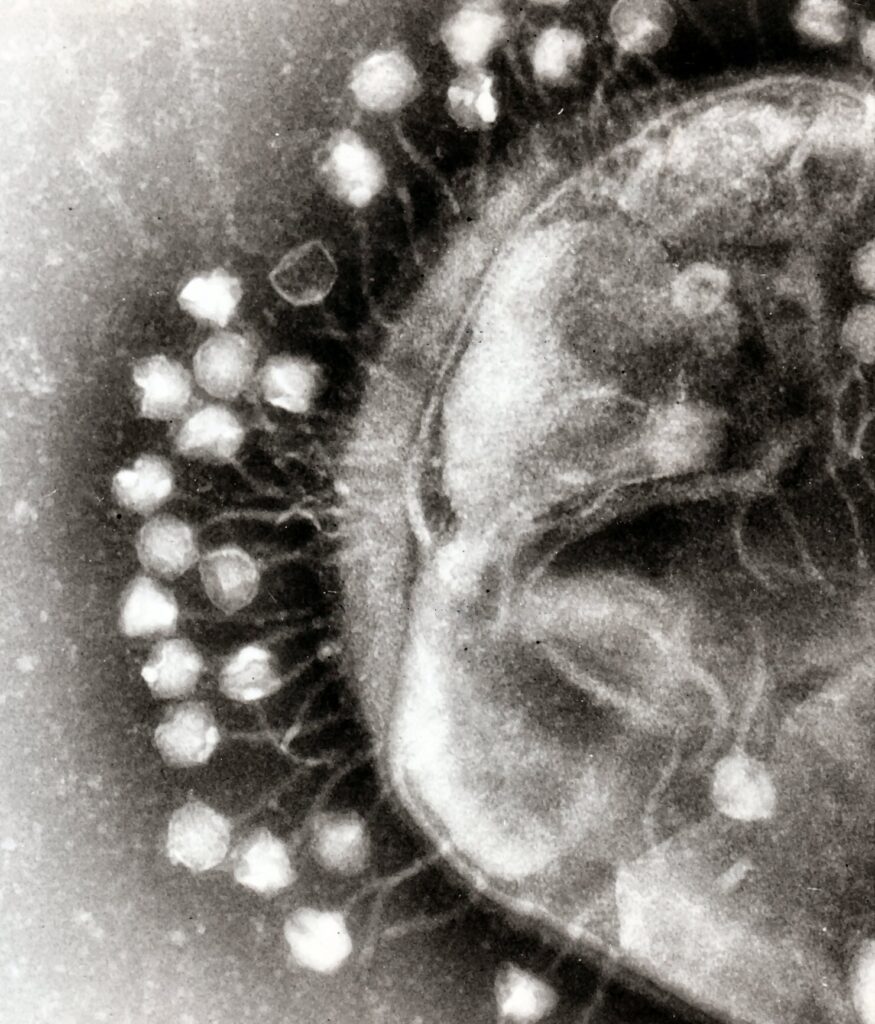
But once the phage or phages are administered, the viruses move fast. While antibiotics typically work in the order of hours to days, phages replicate within minutes. They do so by injecting their genetic material into the bacterial cell, and hijacking the bacteria’s own replication machinery so that it starts to turn out copies of the phage. Once a critical level of replication is achieved, the bacterial cells bursts open – fatal for the bacteria – and releases hundreds of newly minted phage into the surrounding tissue. The cycle repeats and repeats, until there are no bacteria left alive.
Phage therapy isn’t perfect; Professor Barr says the evidence suggests around three-quarters of patients treated do improve, and around 60%-65% show a significant drop in bacterial concentrations. About one in ten people treated with phage therapy experience an immune response to the treatment, which can be unpleasant but not life-threatening. Phage therapy is also more challenging to use in infections such as tuberculosis – which currently is a major antibiotic-resistance problem – because the bacteria that causes the disease is very slow-growing.
“
It’s still an experimental, life-saving, last-resort, compassionate use therapy.
Associate Professor Jeremy Barr
Phages in an AMR-dominated future
But as the power of antibiotics dwindles in the face of rising resistance, phage therapy could potentially be a treatment not only for antibiotic-resistant infections, but as an alternative to antibiotics for bacterial infections. There are also scientific approaches using phages to modify the behaviour of antimicrobial resistant bacteria, and potentially restore their sensitivity to antibiotics.
There are some major regulatory hurdles to overcome, and organisations like Australia’s Therapeutic Goods Administration are meeting regularly with phage researchers from the Phage Australia Network to work towards a framework for evaluating this potentially life-saving treatment. But it’s an exciting time for phage researchers like Associate Professor Barr, particularly given the growing threat of antimicrobial resistance. “Every patient that we treat, we learn a huge amount from and completely change how we treat patients going forward based on those learnings,” he says. “It’s exciting, it’s innovative, and we can have a real-world impact.”
Stream the SBS documentary on phage therapy Last Chance to Save a Life.
Bianca Nogrady is an award-winning science journalist whose reporting on science, health and the environment.
You may also be interested in:

Patients have a common enemy in AMR